Wholemeal bread has a good reputation. It's the loaf most of us reach for when we're trying to eat a bit better, and for years it's been the sensible swap for white bread. So it can be a shock to hear that the wholemeal loaf in your bread bin might count as ultra-processed food.
The short answer is this: most sliced wholemeal bread sold in UK supermarkets is ultra-processed. Wholemeal bread made the traditional way, with just flour, water, yeast and salt, is not. The word on the front of the bag tells you about the flour. It tells you nothing about how the loaf was made or what else went into it.
Here's how to tell the difference, and how to find a wholemeal loaf you can feel good about.
What makes a loaf ultra-processed?
Bread only really needs four things: flour, water, salt and something to make it rise. That's how bakers made it for thousands of years, and it's still how a good local bakery makes it today.
A loaf crosses into ultra-processed territory when it's made in a factory with ingredients you wouldn't use in your own kitchen. Think emulsifiers, preservatives, added oils, extra gluten and flour treatment agents. Researchers who study food processing put traditional bread in the "processed" group and most industrial sliced bread in the "ultra-processed" group for exactly this reason.
The easiest test is the ingredients list. If you spot an E number or an additive under another name, you're looking at an ultra-processed loaf.
What's actually in a supermarket wholemeal loaf
Pick up a sliced wholemeal loaf from one of the UK's biggest bread brands and turn the bag over. This is the ingredients list printed on one of the best sellers:
Wholemeal wheat flour, water, yeast, vegetable oils (rapeseed and palm), salt, wheat gluten, emulsifiers (E481, E471, E472e), soya flour, preservative (calcium propionate), flour treatment agent (ascorbic acid).
Count them up and that's thirteen ingredients for something that only needs four. Here's what the extras are doing in there.
| Ingredient | What it does | Why it's in the loaf |
|---|---|---|
| Emulsifiers (E471, E472e, E481) | Strengthen the dough and keep the crumb soft | Lets the bread survive fast machine mixing and stay squishy for days on the shelf |
| Calcium propionate | Preservative that stops mould growing | Gives the loaf a much longer shelf life than fresh bread |
| Rapeseed and palm oil | Added fat | Softens the texture and helps the loaf keep |
| Extra wheat gluten | Concentrated wheat protein | Props up the dough so it rises fast and holds its shape |
| Soya flour | Dough conditioner | Helps the dough handle well in the factory |
| Ascorbic acid | Flour treatment agent | Speeds up dough development so the loaf can be made in hours, not overnight |
None of these ingredients make the bread more nourishing. They're there to make it faster to produce, softer to squeeze and slower to go off.
It's not just the big brands either. Own-label budget wholemeal loaves follow much the same recipe, with emulsifiers, a preservative, extra gluten and added oil.
The oils are worth a mention on their own. A lot of people now try to cut down on seed oils like rapeseed, and on palm oil for environmental reasons. Most don't expect to find either in a loaf of bread, but they're common in sliced supermarket bread.
The list on the bag may not even be the whole story. Some enzymes used in industrial baking count as "processing aids" and don't have to be declared on the label at all.
What Ivy found when we scanned two popular wholemeal loaves
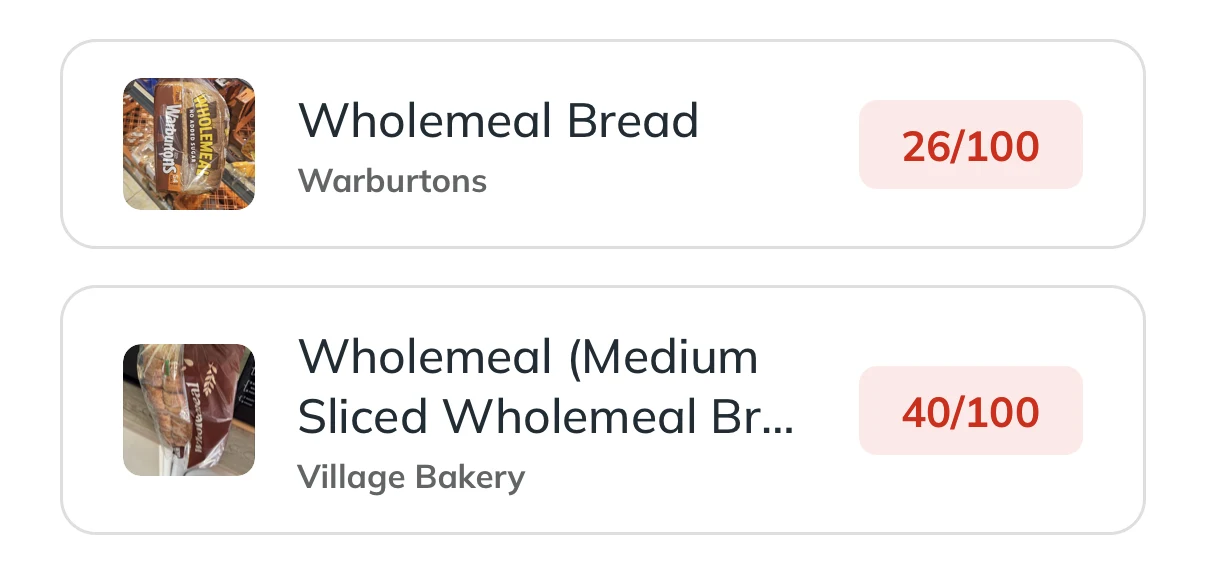
We scanned two wholemeal loaves you'll find in most UK baskets: Warburtons Wholemeal and Village Bakery Medium Sliced Wholemeal. Both say "wholemeal" loud and clear on the front. Neither is as simple as it looks.
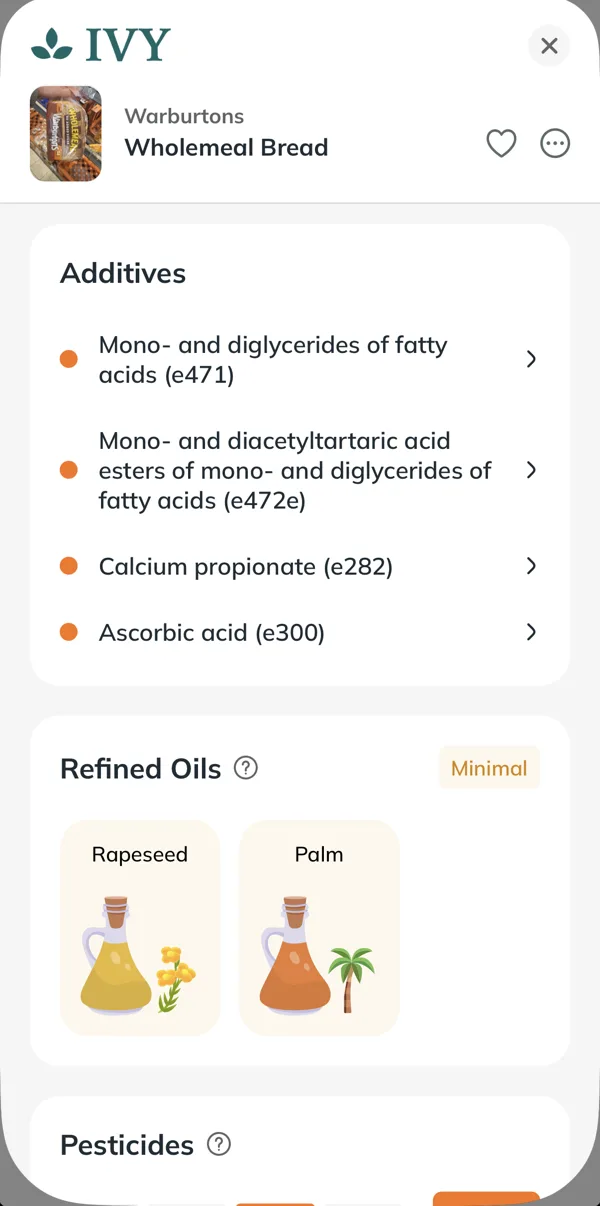
Warburtons Wholemeal scored just 26 out of 100. Ivy flagged four additives: two emulsifiers (E471 and E472e), the preservative calcium propionate (E282) and ascorbic acid (E300). It also picked up two refined oils, rapeseed and palm.
Village Bakery Wholemeal scored 40 out of 100. Ivy flagged four additives here too: ascorbic acid (E300), the emulsifier E471, calcium propionate (E282) and calcium carbonate (E170). It also contains caramelised sugar.
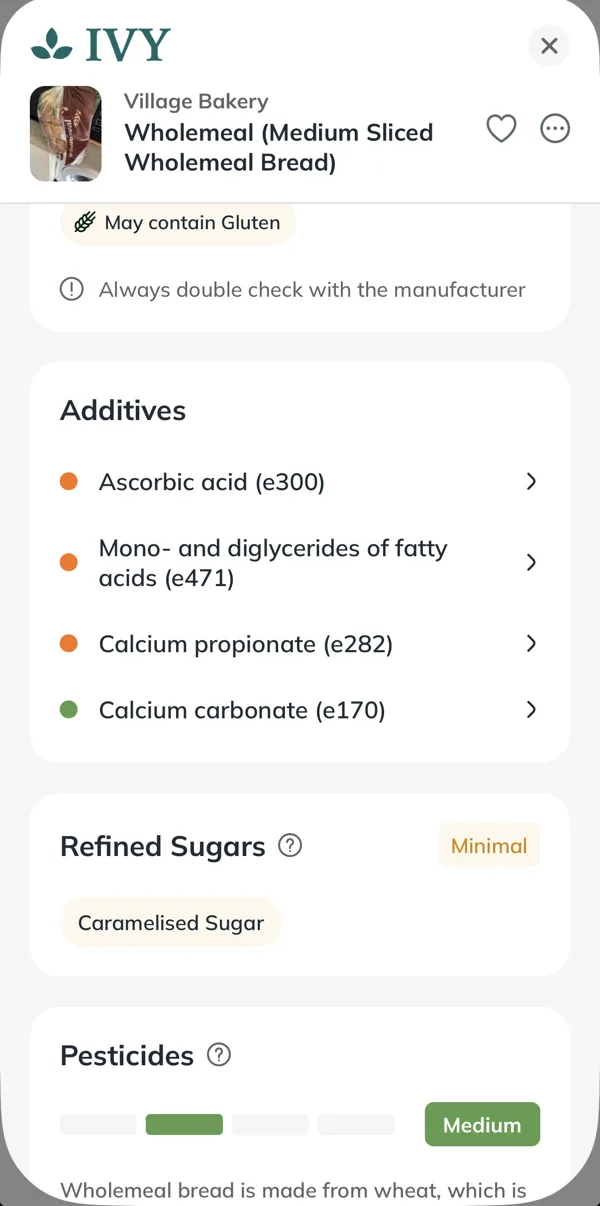
Village Bakery comes out ahead because it has no added seed oils, and one of its four additives, calcium carbonate, is low risk. But neither loaf comes close to a good score. Two different brands, same story: a preservative to keep it on the shelf longer and emulsifiers to keep it soft.
Why shop bread is made this way
Most of the bread on UK shelves is made using the Chorleywood bread process, developed in Hertfordshire in 1961. Instead of leaving dough to rise slowly, it uses a few minutes of intense high-speed mixing, extra yeast, added fat and a flour treatment agent. A bag of flour can become a sliced, wrapped loaf in about three and a half hours.
It was a clever bit of engineering, and it's the reason bread is so cheap. Around 80% of the UK's bread has been made this way. But speed comes at a cost. The long, slow rise that gives bread its flavour and structure gets skipped, so additives step in to do the job that time used to do.
What "wholemeal" on the label really means
In the UK, a loaf can only be called wholemeal if all the flour in it is wholemeal flour. That's the rule under the Bread and Flour Regulations 1998. It's a rule about the flour and nothing else. A wholemeal loaf can legally contain emulsifiers, preservatives, added oils and anything else on the approved list.
Even the flour rule isn't always followed. In 2023, campaigners found refined white flour in several own-brand "wholemeal" loaves from big UK supermarkets. The retailers argued the white flour was only a dusting or a carrier for additives.
So "wholemeal" is a useful word, but it isn't a health stamp. It tells you the loaf should have more fibre than white bread. It doesn't tell you the loaf is free from the extras you might be trying to avoid.
Why sourdough is the better choice
If you want bread without the additive list, proper sourdough is the best option on the shelf.
Real sourdough is made from flour, water and salt. There's no packet yeast. Instead it rises with a starter, a living culture of wild yeasts and bacteria that bakers keep going for years. The dough is left to ferment slowly, often overnight or longer.
That slow rise does the work that additives do in factory bread. It builds structure without extra gluten or flour treatment agents. It also gives sourdough its tangy flavour and chewy crust, and the acidity helps the bread keep better without preservatives. There's also some evidence that traditionally fermented breads raise blood sugar less than typical sliced loaves.
For the best of both worlds, look for a wholemeal or wholegrain sourdough. You get the fibre of wholemeal flour with none of the extras.
Watch out for fake sourdough
There's no legal definition of sourdough in the UK, so some supermarket loaves use the name while still being made with packet yeast, added flavourings or other extras. Before you buy, check the label for these things:
- The ingredients are flour, water and salt, plus maybe seeds or a different grain.
- There's no added yeast, or "sourdough flavouring" or "dried sourdough" doing the work instead of a real starter.
- There are no emulsifiers, preservatives or E numbers.
- There are no added oils.
If you can, buy from a local bakery. Ask how long the dough is fermented. A good baker will be happy to tell you.
Frequently asked questions
Is all wholemeal bread ultra-processed?
No. Wholemeal bread made with just wholemeal flour, water, yeast and salt is not ultra-processed. Most sliced, packaged wholemeal bread from supermarkets is, because it contains emulsifiers, preservatives and other additives.
Is brown bread ultra-processed?
Usually, yes, if it's a sliced supermarket loaf. Brown, seeded and "50/50" loaves tend to be made the same way as white sliced bread. Check the ingredients for E numbers, added oils and preservatives.
What is calcium propionate in bread?
It's a preservative that stops mould from growing, so the loaf lasts longer on the shelf. You won't find it in fresh bakery bread or real sourdough.
Why is there oil in my bread?
Vegetable oils like rapeseed and palm are added to sliced bread to soften the texture and help it stay fresh for longer. Traditional bread doesn't need any.
Is supermarket sourdough ultra-processed?
Some of it is. There's no legal definition of sourdough, so read the label. Real sourdough contains flour, water and salt, with no added yeast, emulsifiers or preservatives.
What's the healthiest bread to buy in the UK?
A wholemeal or wholegrain sourdough with a short ingredients list is hard to beat. You get the fibre from the whole grain and none of the additives found in most sliced bread.
The bottom line
Wholemeal flour is a good thing. The trouble is everything that tends to come with it. Most sliced wholemeal bread in UK supermarkets is made fast, in a factory, with emulsifiers, preservatives and added oils that a home baker would never use. That makes it ultra-processed, whatever the label on the front says.
If you'd rather keep your bread simple, switch to a real sourdough, ideally a wholemeal one. Check that the ingredients list is short and boring: flour, water, salt. If it's longer than that, put it back.
The quickest way to check any loaf is to scan it. Point Ivy at the barcode and you'll see every additive, oil and sugar in seconds, along with cleaner alternatives you can swap to.